



Young informal caregivers in higher education
Julie Vanderlinden (PhD), Odisee University of applied Sciences (Belgium)
Abstract
Did you know that around one in five students in higher education is balancing their studies with caring for a loved one? Despite their resilience, these young carers often remain invisible within our institutions, facing hidden challenges that impact their wellbeing, academic success, and future opportunities.
In this webinar, we shine a spotlight on these students and explore what higher education can do to better support them. You will gain insight into the diverse realities of young carers, from emotional and practical caregiving responsibilities to the profound effects on study progress, mental wellbeing, and life choices.
Together, we will move beyond awareness and focus on action. Through concrete examples and real-life experiences, we will show how institutions can create more flexible, inclusive, and supportive learning environments, by recognising signals, reducing stigma, and implementing meaningful support structures such as accessible contact points and tailored policies.
Whether you are an educator, policymaker, or student support professional, this webinar will leave you with practical tools and fresh inspiration to make a real difference. Join us in building a more inclusive higher education system where every student, also those with care responsibilities, can thrive.
Register here
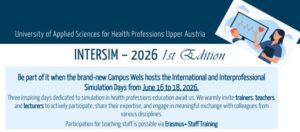
Three inspiring days dedicated to simulation in health professions education await us. We warmly invite trainers, teachers, and lecturers to actively participate, share their expertise, and engage in meaningful exchange with colleagues from various disciplines.
Participation for teaching staff is possible via Erasmus+ Staff Training.
More information about registration, travel & accomodation? See FLYER or get in touch with Erich Weiss (erich.weiss@fhgooe.ac.at)
Flyer
Stress and sleep problems in young onset dementia
Julie Vanderlinden (PhD), Odisee University of applied Sciences (Belgium)
Abstract
How can we better support people with young-onset dementia and their families when anxiety, stress and sleep problems become part of everyday life? Despite their profound impact, these psychosocial challenges are often insufficiently addressed in current care, and fragmented care systems further complicate support across home and care settings.
In this webinar, we present insights from a co-creative research project that explores how to strengthen and connect expertise across (semi)residential care and the home environment. Drawing on qualitative research with care professionals, people with young-onset dementia and their caregivers, we highlight how anxiety, stress and sleep problems are deeply intertwined and affect not only individuals, but entire care networks.
We will introduce the “Connected Care” framework, developed to bridge gaps between care settings and to support a more integrated, person-centred approach. Central to this framework are: strengthening care professionals’ competencies, improving communication and collaboration with the home context, and implementing practical, non-pharmacological strategies.
Building on the YOUNG-D programme, a structured psychosocial intervention developed to enhance coping with anxiety, stress and sleep problems, the webinar will demonstrate how evidence-informed techniques, such as breathing exercises, mindfulness and cognitive-behavioural strategies, can be translated into everyday care practice.
Participants will gain:
- Insight into the psychosocial needs of people with young-onset dementia and their caregivers
- Practical tools to reduce anxiety, stress and sleep disturbances
- Inspiration on how to strengthen collaboration across care settings
- Concrete examples of how to act as a “bridge” between professional care and the home environment
This webinar invites healthcare professionals, researchers and policymakers to rethink care as a connected, collaborative process, where expertise does not stop at the walls of an institution, but actively supports life at home.
Register here

More details will follow soon!

EMOTIONAL SUPPORT FOR STUDENTS AFTER VERY STRONG EXPERIENCES
a COHEHRE workshop in collaboration with CrisisCare
TIME & PLACE
7-8-9 October 2026, Wien University of Applied Sciences
WHO
All teachers and coaches who are involved in sending students for exchange to poor resourced countries or are planning to do so.
WHAT
3 day hands-on workshop
GOAL
This training focuses on equipping students with the skills and strategies needed to respond effectively during and after critical incidents and crises.
PROGRAMME
The programme consists out of keynotes, workshops, panel discussion with international experts, self-experience exercises, discussion, and inter-vision.
LEARNING OUTCOMES
· Raise awareness of paradigm shifts needed for working in poor-resourced countries
· Build students’ intercultural and interprofessional skills for non-European settings
· Prepare and orient students for clinical practice in poor-resourced countries
· Supervise and coach students placed in poor-resourced countries
· Support students emotionally before, during, and after placement
· Equip students to respond effectively to critical incidents and crises
· Share strategies with colleagues on developing culturally competent healthcare and education
HERE you can register and find more info on the programme and speakers!

We are pleased to present the new program for the ZHAW International Winter School 2027.
The Winter School offers study opportunities for approx.100 international students in five different interprofessional courses. Participants can choose from a variety of on-site and online courses in English or German.
When
11 January 2027 – 5 February 2027 all-day
Where
ZHAW School of Health Sciences, Winterthur, Switzerland
Cost
Check link for more info
Registration
-> All courses are open for registration from June onwards via our website for students of health professions and social work.
Contact
International Relations
T 0589344088
M international.gesundheit@zhaw.ch
Did we spark your interest? You and your students will find the new program and all necessary information on our website.
Partner universities:
- Please note that a limited number of places will be reserved for students from each of our partner universities until 30 September 2026. Your students can directly register via our website.
- Please note that the online payment needs to be completed as part of the registration process.
- Please be aware that courses have limited capacity, and some of them rely on a good mix of different health and social care professionals to deliver the desired benefit. We will do our best to accommodate each student’s first choice, but in some cases, we might ask them to choose an alternative option.
- Please do not hesitate to contact us under gesundheit@zhaw.ch with any questions you may have. We are happy to help!
We are looking forward to welcoming your students and experiencing an unforgettable and inspiring International Winter School 2027.